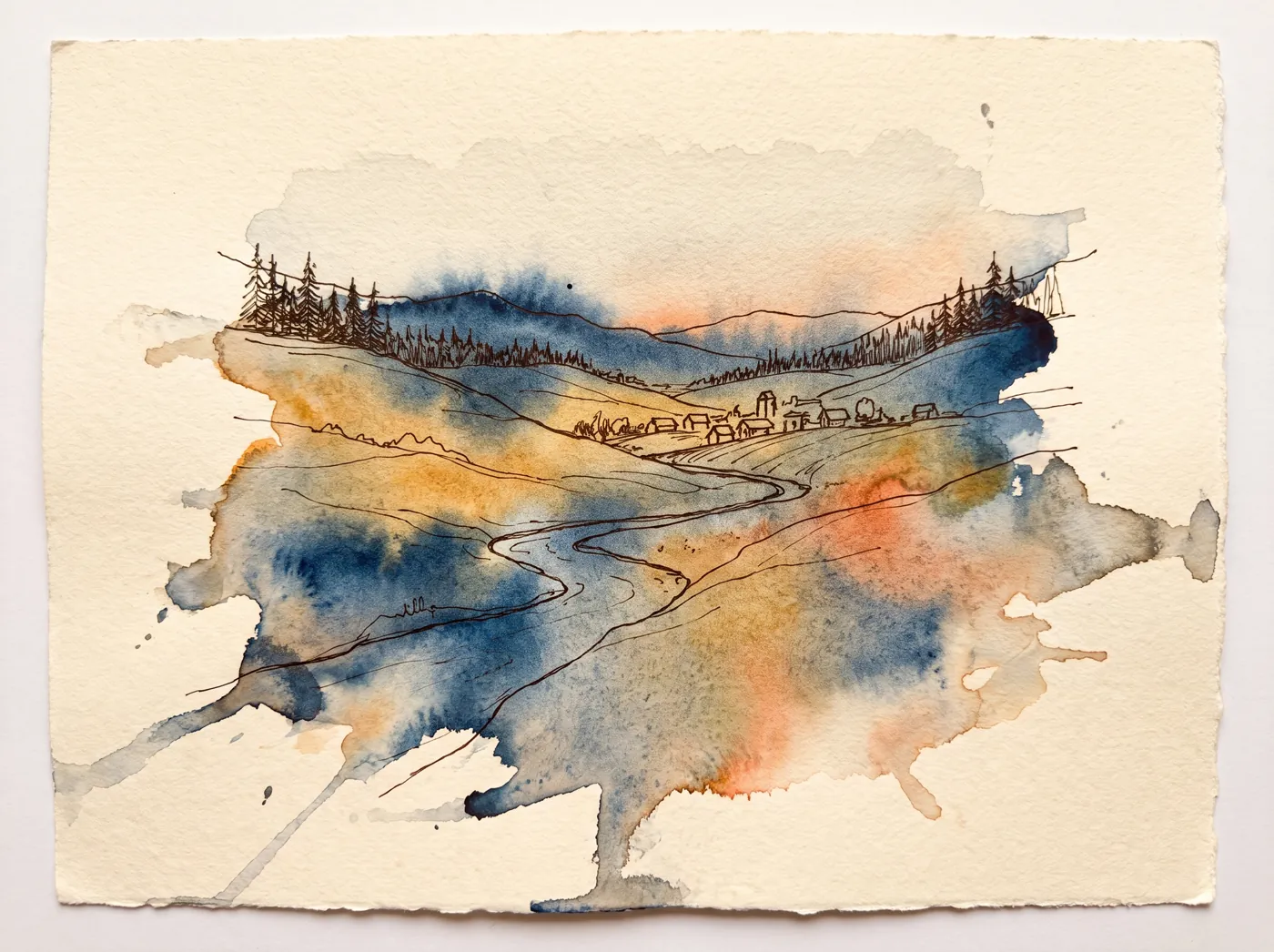
In a world that forgot why it was made, one boy still carried the light.
Prologue · Chapter One
Prologue
The Fading of Kavan
In the beginning of all beginnings — so the oldest songs say, and by now almost no one sings them — a Voice moved over the empty dark, and the world was sung into being. And nothing in that song was sung by accident: not one stone, not one sparrow, not one small gray moth. Into each thing a purpose was breathed, folded inside it like a secret name. And here is the strangest and truest thing about the world of Kavan: purpose could be seen. It shone. It had color.
The rivers ran blue because they knew where they were going. The wheat stood gold because it knew who it would feed. The pines on the high ridges wore the deepest green, for they had been told to hold the mountains still when the winter winds came. Even the smallest things burned with their little flames of color — a red beetle who was made to make children laugh, a violet at the roadside whose whole purpose was to be found by someone weeping.
And the people — oh, the people were the brightest of all. For into every man and woman and child had been sung not one purpose but a purpose all their own, unrepeatable, like a fingerprint of light. In those days you could stand on a hill above any town of Kavan at evening and see it glowing like a field of embers, every soul a different color, and no two the same.
Nothing in that song was sung by accident.
✦ ✦ ✦
No one remembers when the Fading began. That is the terrible thing about forgetting — it does not arrive like an army, with drums and banners. It comes the way dusk comes, so slowly that no one can say the moment the light left.
It began with the questions. In the old days, every child of Kavan was taught to ask the oldest question in the world: “Why was I made?” — and to keep asking it until the answer warmed in their chest like a coal. But the people grew busy, and then they grew clever, and then they grew tired. They said: A river is just water. Wheat is just food. A person is just a person, and there is no why. They stopped asking. And a purpose that is never asked about is like a fire that is never fed.
The colors did not vanish all at once. First the far mountains went gray, and people said it was only mist. Then the wheat forgot who it would feed, and stood ash-pale in the fields, and people said it was only a hard year. Then one morning a mother looked at her own child and could not remember what color his eyes had been, and by then it was too late to say it was only anything.
The world went gray. Not black, which at least is something — but gray, which is the color of nothing in particular. And you must not imagine — this is important, for it is the whole terror of the thing — you must not imagine a world of weeping. Nobody wept. The towns still stood; the harvests still came in; people worked, and married, and kept their holidays after a fashion, and laughed at supper, and if you had asked them — anyone, anywhere — whether they were happy, they would have said yes, and meant it, and gone back to what they were doing. Nothing hurt. Nothing was missing that anyone could name. The Fading did not feel like dying. It felt like being fine. And that was the deepest part of it, for a wound that aches can be found, and a wound that burns can be found, but a wound that smiles is safe forever: the world forgot that it had forgotten, and was content.
✦ ✦ ✦
Almost no one.
In a small town at the edge of the gray hills — a town so faded it had even let go of its own name — there lived a boy of thirteen. His grandmother, who was the last in that country to remember the old words, had named him Lior, which in the first language means my light.
And Lior shone.
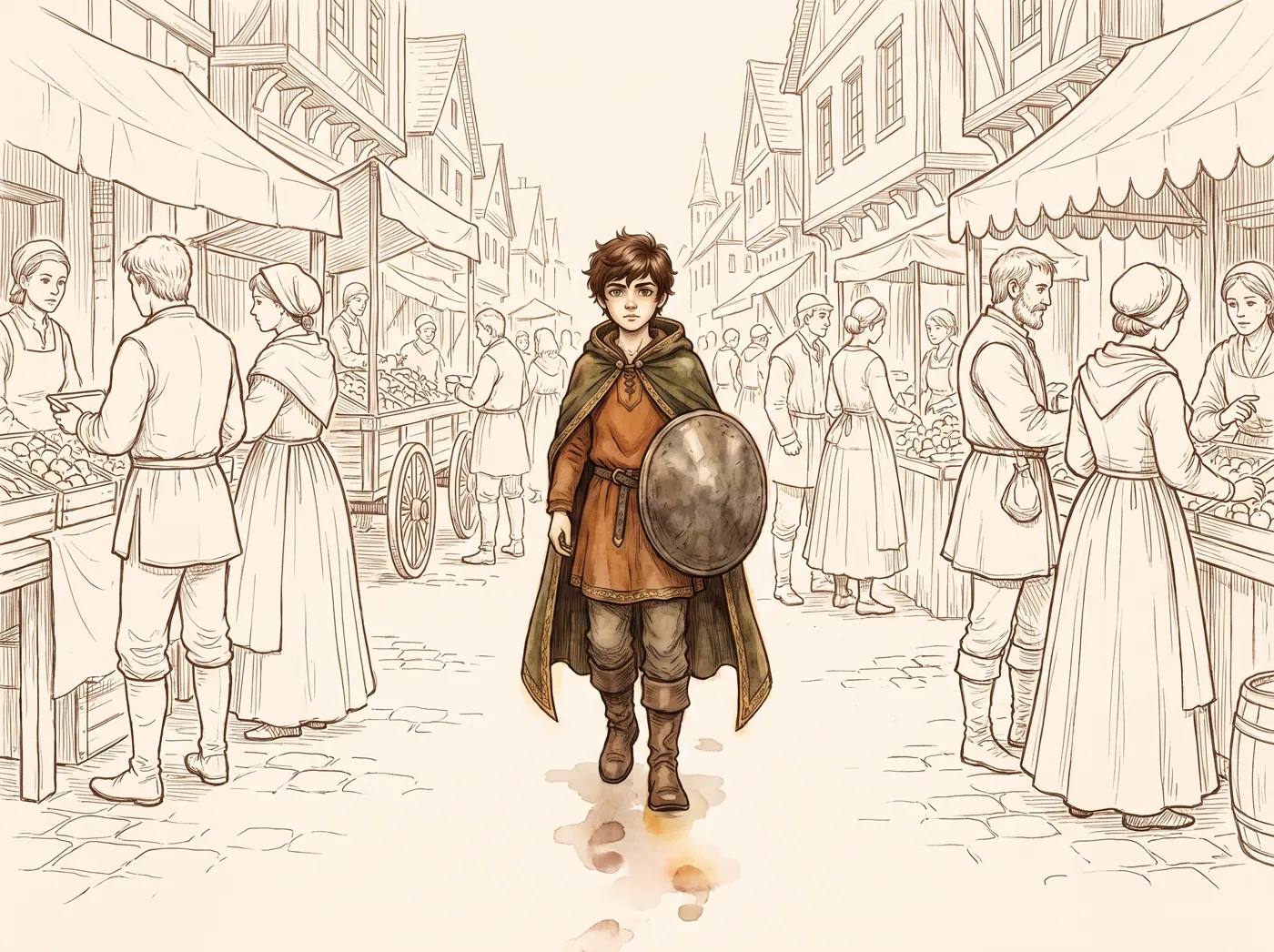
Not brightly, not like a lantern — but truly, the way the first star is true in an empty sky. His eyes were brown as turned earth in spring. His cloak, patched by his grandmother, held a stubborn thread of gold. And here is the loneliest thing about the boy's whole childhood: no one ever saw it. For to see a color you must still be asking about it, and the gray had stopped. Whatever shone on Lior fell on their eyes and found the doors shut; the brightest thing in the province grew up in the middle of a market town, and was never once noticed, and learned to believe that being unseen is simply what shining is.
Why did the Fading never touch him? Perhaps it was this: every night of his life, his grandmother had knelt with him at the window and asked the oldest question — “Lior, why were you made?” — and every night he had answered, and every night the answer had been a little different and a little truer. He was the last child in Kavan who had never once stopped asking. And a fire that is fed every day does not go out.
Colors trailed after him like a rumor.
On the morning his grandmother died, she pressed his hand to the window glass, toward the gray hills and the gray roads and the hundred gray towns beyond them, and she gave him the last words she had.
“The world has not lost its colors, my light.
It has only lost its why.
Go and ask the question for those
who have forgotten how to ask it.
Where the why returns, the color will follow.
And when the gray fights back — for it will fight —
do not fight for yourself. Stand in front of someone.”
So the boy buried her beneath the one tree that had stayed half-green because she had loved it, and he mended his cloak, and he filled a small pack with bread and a stub of candle. Last of all he took down the one thing in the house she had never let him touch: a round shield of old bronze that had hung above the hearth longer than anyone could say, gray with years — though if you looked at it slantwise, in a certain light, you could just make out the worn engraving of a rising sun. It was far too heavy for a boy of thirteen. He carried it anyway. And at dawn, while the nameless town slept its gray sleep, Lior stepped onto the long road east —
— a single spark, walking out to set a whole world burning with color again.
Chapter One
The Town of Turning Wheels
For nine days Lior walked the eastern road, and for nine days the road did not care. The hills were gray, and the sky was gray, and the crows that watched him from the fence posts were gray, and had forgotten even how to be curious about a boy in a gold-threaded cloak, carrying a bronze shield nearly as tall as himself. But wherever his feet fell, something small happened that no one was there to see: a blade of grass at the road's edge would remember, just for a moment, that it had been made green — and blush with it — and then, when he had passed, sigh back into ash.
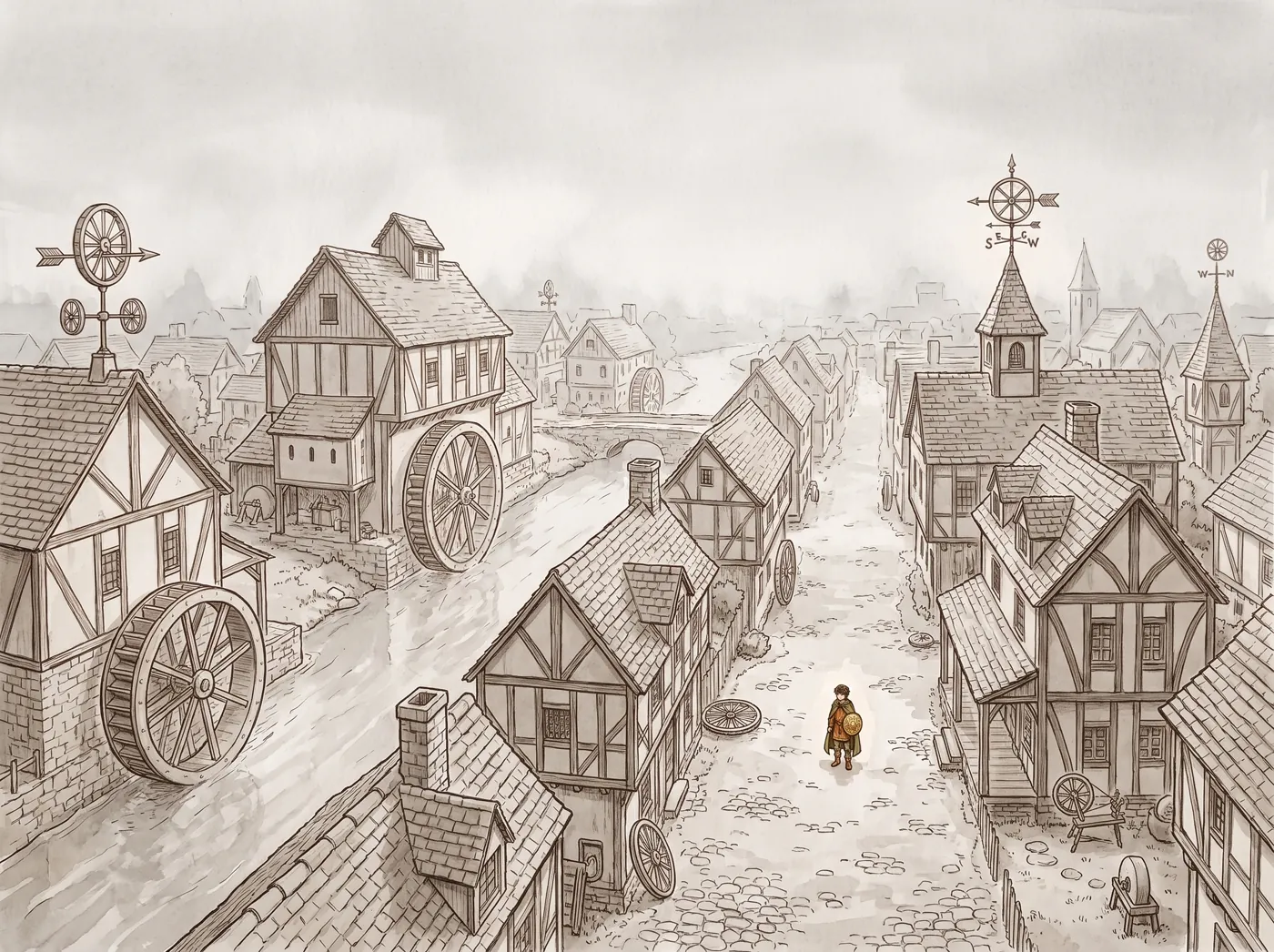
On the tenth morning he heard the town before he saw it: a great, patient groaning, like a beast turning in its sleep. Then the road bent around a hill, and there it lay in the valley — the town of Hevel, built along a slow gray river, and every house in it had a wheel.
Mill wheels turned in the river. Cart wheels turned in the streets. Spinning wheels turned in the doorways, and grindstones turned in the yards, and even the weathervanes turned, though there was no wind worth naming. The whole town moved, day and night, and had moved for as long as anyone living could remember. And here is what the songs made afterward always get wrong, and what must be set down plainly: Hevel was not a sad town. No one wept in Hevel. No one starved. The mills ground flour that tasted of nothing, and everyone ate it with a good appetite; the spinners spun cloth the color of river fog, and wore it comfortably; the carts carried the flour to the ovens and the bread to the tables and the crumbs to the pigs, around and around, like the wheels themselves, and the whole town slept soundly to the sound of it. Ask anyone in Hevel whether they were happy and they would say yes — and they would not be lying. Nothing was wrong in Hevel. Nothing had been wrong in Hevel for fifty years. That, though it took Lior a long time to find the words for it, was exactly what was wrong with it.
When Lior came down the main street, no one looked at him at all. Not rudeness — blindness of a particular kind, for seeing takes wondering, and wondering was one of the things Hevel had let go. A boy burning like a struck match walked the whole length of the town, and the town parted around him as around any stranger's cart, and closed again behind him, incurious as water. Only a carter's horse stopped in the middle of the road and would not walk on, its great gray nostrils drinking the air around the boy as if it smelled rain after a hundred dry years — for beasts have never asked anything, and so had nothing the gray could take, and a horse knows rain when it smells it.
Nothing had been wrong in Hevel for fifty years. That was exactly what was wrong with it.
✦ ✦ ✦
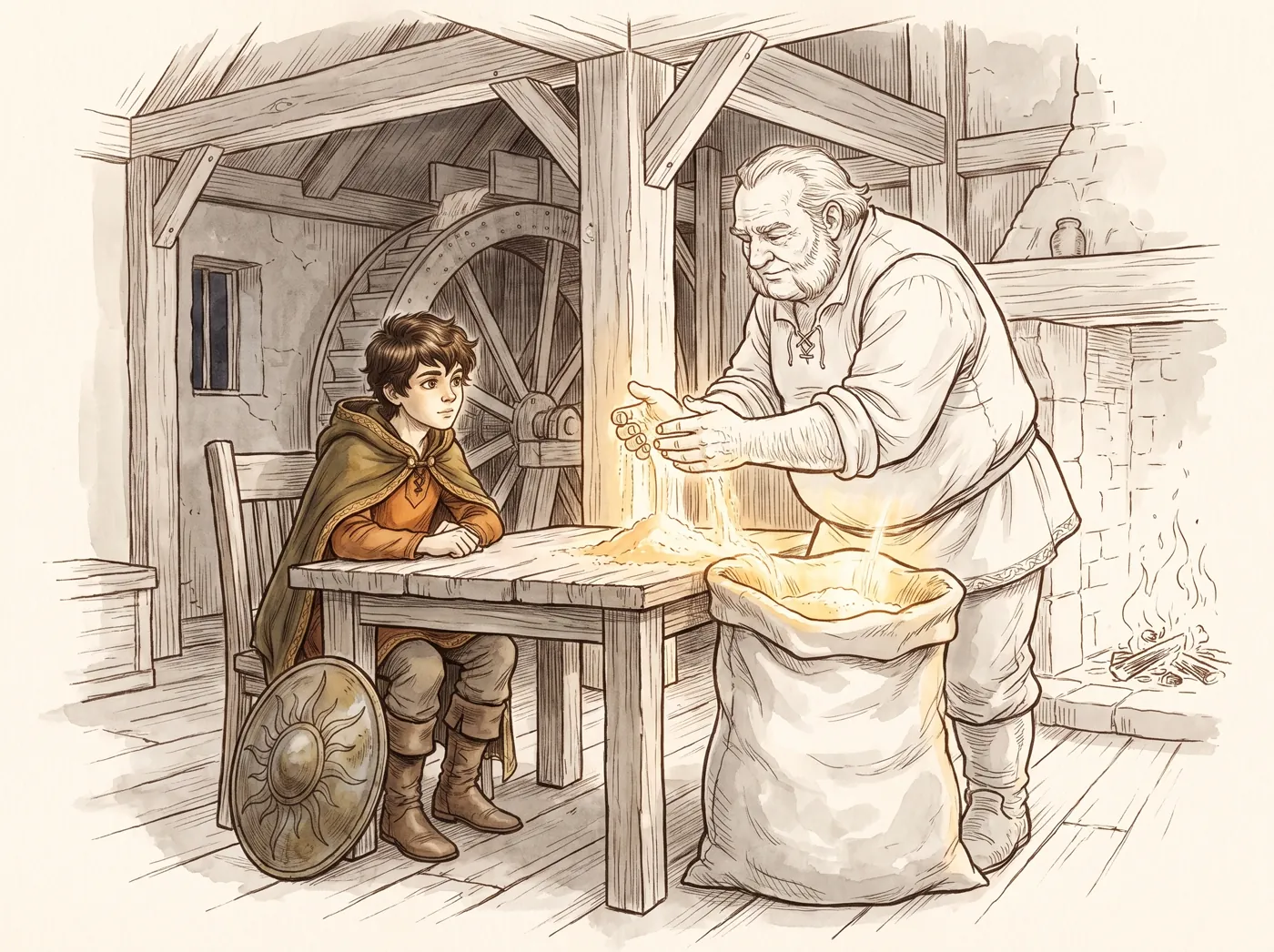
The oldest mill in Hevel stood at the far end of town, where the river ran deepest, and it belonged to a miller named Amos. He was a huge man gone the color of his own flour, with forearms like rolled dough and eyes like two shuttered windows. Lior found him at dusk, feeding grain into the hopper with the steady, empty motion of a man who could do it in his sleep — and, in every way that mattered, was.
“No work for strangers,” Amos said, without turning around.
“I'm not looking for work,” said Lior. “I'm looking for supper, and I can pay for it with a question.”
“Questions,” said the miller, in the way another man might say rats. But it had been a long time since anything new had come down the eastern road, and even a gray heart keeps one door unlatched. He jerked his chin at the millhouse, where a pot of colorless porridge hung over a colorless fire, and they ate in silence while the great wheel groaned outside in the dark.
When the bowls were empty, Lior asked it. The oldest question in the world, the one his grandmother had fed him every night like bread:
“Amos — why was this mill made?”
The miller snorted. “To grind.”
“And why does it grind?”
“To make flour.” The shuttered eyes narrowed. “Flour makes bread. Bread gets eaten. Then they're hungry again, and the wheel goes round. That's all it is, boy. Wheels inside wheels. Vapor and wind.” He said it the way the whole town said everything — flat, final, like a door closing. “There is no why.”
Lior was quiet for a moment. Then he said, “Who taught you to work the mill?”
And something happened to the miller's face. It was small — the flicker of a muscle, no more — but in a town where nothing had happened in a lifetime, it was an avalanche. “My father,” said Amos, slowly, as if the words were being ground out of some deep, unused part of him. “I stood on a stool to reach the hopper. I was six. He put his hands over my hands.” The shuttered windows opened, just a crack. “He used to say... he used to say we were not making flour at all. He'd hold up a fistful and let it run through his fingers and say, Amos, look close — this is the valley's winter. This is the widow's table. This is why our wheel was hung on this river before your grandfather's grandfather. He said grinding was only what our hands did. Feeding was what the mill was for.”
The word hung in the millhouse air like a struck bell. For.
And the flour remembered.
It began in the open sack by the door — a warmth creeping through the meal like dawn through fog, gray turning to cream, cream to the soft gold of ripe wheat, until the whole sack glowed like a lamp. The smell reached them next, and it nearly broke the old man: the deep, sweet, sunlit smell of real grain, which he had not smelled since he was six years old and did not know he had been starving for. Outside, the great wheel groaned on — but the groan had changed. It had somewhere to go now. It sounded, for the first time in fifty years, like a wheel that was carrying something.
Grinding was only what our hands did. Feeding was what the mill was for.
And then the miller turned from the glowing sack and looked at his guest, and made a sound like a man struck. For his why had woken, and his eyes had woken with it, and for the first time he could see what had been sitting at his table all evening — the brown of the boy's eyes, the impossible gold in the gray cloak, the quiet shine of him. No one had ever looked at Lior like that in his life. That, he would learn, is how you know a remembering has taken root: not the color coming back to the flour, but the moment they turn, and their face changes, and you feel like weather that has finally been noticed. Amos wept, in the way that stone walls weep — slowly, and from somewhere deep. And when he had finished, he did not sleep. He fired the millhouse oven, and set the first true dough in Hevel in half a hundred years to rise in the warm dark.
That was when the humming began.
✦ ✦ ✦
It came up the river with the midnight fog — a sound at the very bottom of hearing, flat and patient, like a thought being slowly erased. Lior knew it before he knew he knew it, the way you know a smell from a bad dream. His grandmother had a name for the things that made it, a name from the first language that she would only say indoors, with the lamp lit: the Shikha. The Forgetting Lights. “The gray does not keep itself, my light,” she had told him. “It is kept.”
They poured out of the fog and out of the mill wheel itself — and Lior understood, all at once, why the great wheel had groaned so for fifty years. Something had been nesting in its heart. They were shaped like little flames, if a flame could be made of ash and gray glass — pale cold wisps the size of a clenched fist, drifting the way marsh-lights drift over drowned ground, and where they gathered the lamplight went dim and dirty. Their touch did not take blood. It took the why. One touch and a man would look down at his own two hands and not remember what they were for.
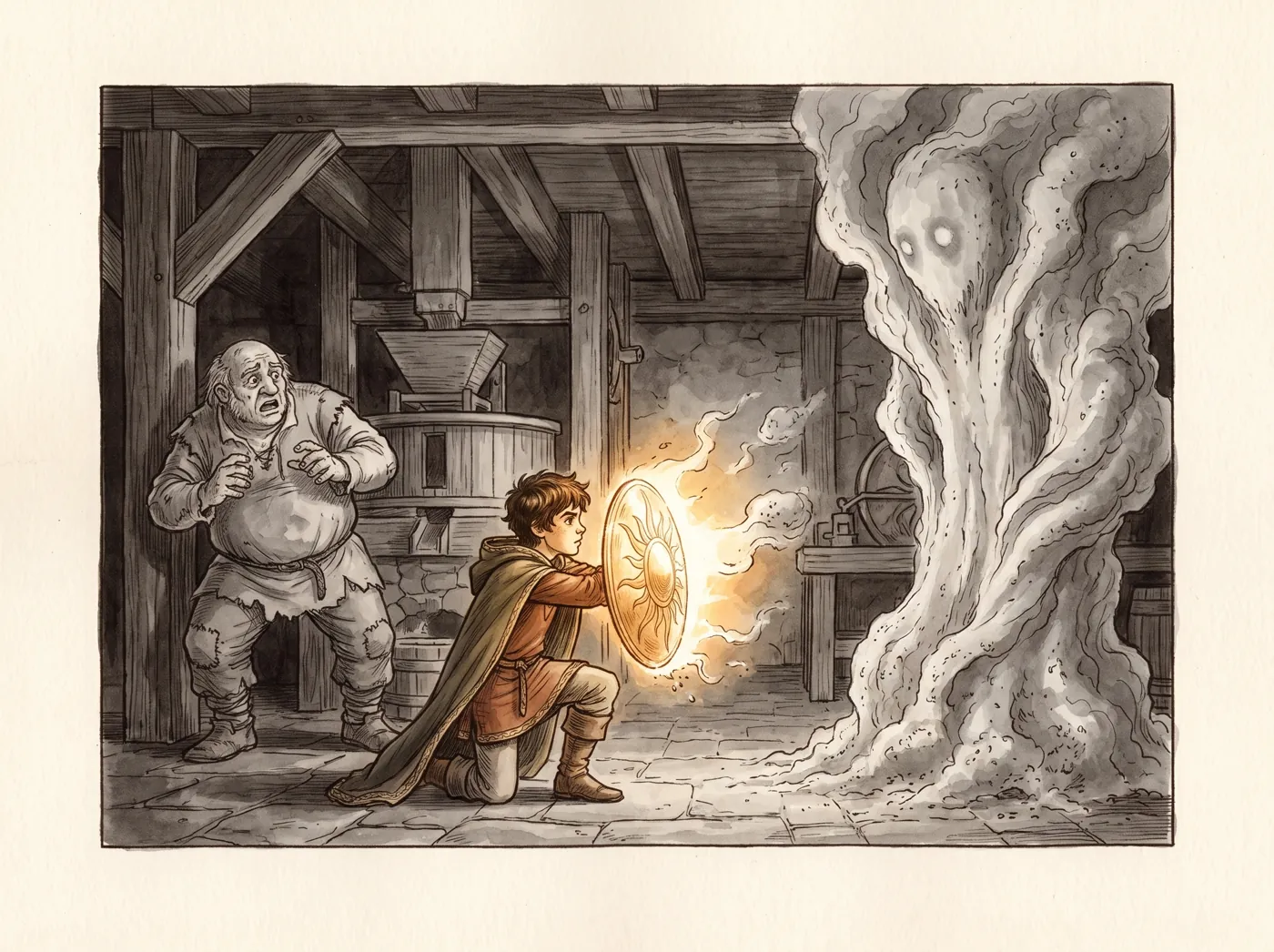
Amos stood frozen in the millhouse door with the golden flour glowing behind him — for it was the color they had come for, the way moths come for a flame. And Lior did what he had been made to do, though he was only learning it that night. He did not run at the swarm. He did not run from it. He stepped in front of the miller, planted his feet the way you plant a fence post, and swung the great bronze shield off his back.
“You want it back?” he called into the humming dark, and his voice cracked in the middle, because he was thirteen and terrified. “Then come take it through me.”
The swarm took the invitation. They broke over him like gray surf, and their cold fire washed and skidded on the bronze, and the ones that found his skin found nothing they could carry away — for you cannot steal the why from a boy who has answered for it every night of his life. It is driven in too deep. It has roots. And with every touch of that cold fire the shield grew warmer under his arm, and the worn engraving of the rising sun began, faintly and then not faintly at all, to shine — because that is the secret of the old bronze, which the smiths of the first days knew: it does not wake for anger, and it does not wake for fear. It wakes when its bearer stands in front of someone.
Then the mill wheel stopped turning, for the first time in living memory, and the Sentinel came out.
It was to the swarm what the bonfire is to the spark — a wisp the size of an ox, a hollow gray flame that burned cold and cast no light but a kind of dark, and where its glow fell the new gold of the flour sack guttered like a candle in wind. It did not hurry. The gray never hurries. It regarded the shining boy with eyes like buttons of fog, and the humming formed itself almost into words: lie down. forget. it is easier.
“No,” said Lior — the smallest battle cry in the history of the world — and raised the sun.
The Sentinel struck him three times. The first blow drove him back a full stride, boots plowing the flour-dusted floor. The second buckled his knees. The third he took kneeling, both arms behind the bronze, teeth bare, and did not go down — and that, though he could not know it yet, is the whole art of the warriors of the first days: not to strike hardest, but to still be standing when the striking is done. The Sentinel drew back for a fourth blow. And the shield, now blazing like a piece of noon broken off and carried into the night, answered instead: light burst from the rising sun in a soundless wave, and where it touched the swarm, the little lights guttered out and settled as gray dust, and where it touched the Sentinel, the great fog-eyed thing shrieked — a sound like a wet finger dragged down glass — thinned, and flickered, and went out the way a lie goes out of a room when the truth walks in.
Not to strike hardest — but to still be standing when the striking is done.
And here is the thing the songs would remember afterward, when there were songs again. The gray did not simply fade from that place. It let go — like a fist unclenching. Color rushed into the mill quarter of Hevel the way water rushes into a footprint on the shore: the river ran suddenly blue beneath the wheel, the wheel's old timbers remembered they had been cut from red cedar, the millhouse roof blushed slate-purple, and every rooftop and fencepost and sleeping cat for a hundred paces around woke into its own true color, all at once, in the middle of the night. Beyond that — nothing. At the edge of the mill quarter the color stopped, clean as a shoreline, and the rest of Hevel lay gray as ever under the fog. For each Sentinel keeps its own small dominion, and Lior had broken only one. But inside that shoreline, the world was the world again.
✦ ✦ ✦
At first light Amos carried the true bread out into the streets and began, with no explanation at all, to give it away. You must not think the whole town changed in a morning. The Fading was old and deep, and one bright quarter cannot argue with fifty gray years. Most of Hevel came and stood at the color's edge the way you might stand at the sea — moved, and troubled, and unable to say why. Some grew frightened and shut their doors, for color asks things of a person that gray never does. But the children crossed the shoreline at once, laughing, the way children do; and the horses turned their heads toward the mill all day long; and the widow at the end of the lane ate her portion of bread and wept without knowing the reason, and her kitchen curtains — just the curtains, just at the hem — remembered they had once been blue.
Lior stayed three days, sleeping in the millhouse loft while his bruises turned the honest colors bruises should. He asked his question at the spinner's door and the carter's yard, and where it was answered, small fires of color woke to meet the bright quarter's edge; and where it was not, he did not force it, for a why cannot be given, only remembered. On the fourth morning Amos filled the boy's pack with golden loaves and walked him to the edge of town, and stood there a long while, a huge cream-and-gold figure at the border of his own small restored world, watching him go.
“Boy,” he called at last. “What you broke in my wheel — there are more. Every town east of here groans somewhere, if you listen. Nests in the bell towers. Nests in the wells. And they say in the city of Nekhar even the river has stopped asking which way the sea is.” He hesitated, turning his hat in his flour-dusted hands. “And they say the Shikha do not keep the gray for themselves. Something sends them, boy. Something that has a nest of its own, far out in the east, and hates the asking of questions more than it hates anything under the sky.”
Lior looked down the long eastern road, where the hills lay ashen under an ashen sky, all the way to the edge of seeing. Somewhere far off — too far to be sure — something cold seemed to notice him back.
He settled his pack, and the gold thread in his cloak caught the morning's thin light.
“Then it had better learn to like questions,” he said — and walked east.